Older Home Electrical Inspections, Rewiring & Safety Guide
Buying an older home? Learn how electrical inspections, smart rewiring decisions, and spotting fire-safety red flags can protect your family and investment.
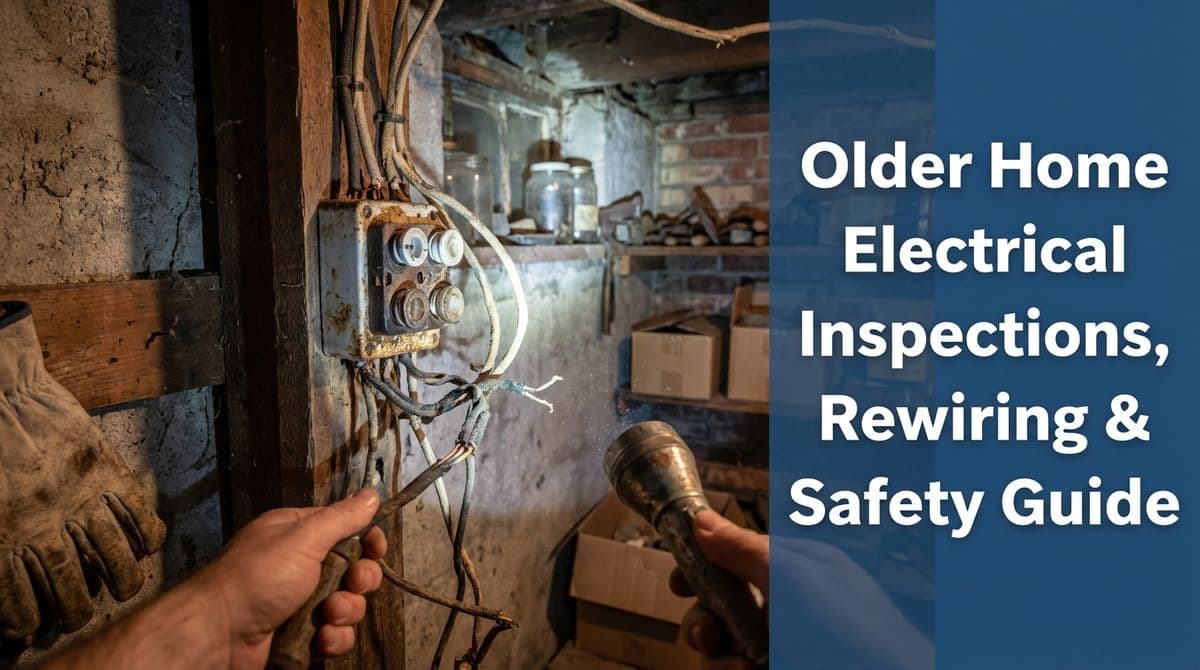
Buying an Older Home? Here’s How We Tackle Electrical Safety
We recently got a call from a homeowner — let’s call him Dan — who had just bought a small lake house built in 1967. About 750 square feet with a finished basement, perfect little getaway spot. The only problem? Once he popped his head into the attic, he realized the wiring looked like a plate of spaghetti.
Dan told us he’d cut an access hole, climbed up, and found wires running in every direction, junction boxes stuffed with six or more cables, one box with no cover, and connections just taped together with no wire nuts. In the bathroom, he replaced the exhaust fan and discovered a junction box sitting right on top of the fan with six or seven hot wires jammed into a single wire nut. He’d also noticed dead cables that had been cut and left hanging after an old remodel — and he wasn’t sure which of them might still be live.
As he put it, “I can’t have that.” And he’s right. In an older home, that kind of wiring is more than just ugly — it’s a fire hazard.
Step One: Why a Full Electrical Inspection Matters
The first thing we explained to Dan — and what we recommend to anyone buying an older home — is that you start with a comprehensive electrical inspection. Before you talk about rewiring or pricing, you need a clear baseline.
On a typical inspection of a 1960s-era home, we’ll:
- Inspect the main service panel and any subpanels (capacity, condition, labeling, grounding, and bonding)
- Check visible wiring in the attic, basement, crawlspaces, and mechanical areas
- Open a sampling of switches, outlets, and junction boxes to see how connections were made
- Test circuits for proper grounding and GFCI/AFCI protection where required
- Look for signs of DIY work, past remodels, or abandoned/“mystery” wiring
In Dan’s case, the attic alone told us there had been a lot of homeowner or handyman work over the years — and very little of it met modern safety standards.
Rewire or Repair? How We Decide
Dan’s big question was, “Do I need a full rewire, or can we just fix what’s obviously wrong?” That’s a common concern, and the honest answer is: it depends what we find once we really start looking.
Here’s how we usually break it down with buyers of older homes:
When targeted repairs may be enough
If the home’s wiring is generally consistent and in decent shape, we may recommend focused repairs instead of a full rewire. That might include:
- Correcting unsafe junctions (adding proper boxes, covers, and wire nuts)
- Removing or properly terminating dead/abandoned wiring
- Replacing damaged runs of cable in specific areas
- Updating circuits in kitchens, bathrooms, and laundry rooms for GFCI protection
- Adding dedicated circuits for heavy loads (HVAC, water heaters, etc.)
This approach can make a big improvement in safety without the cost and disruption of opening up every wall in the house.
When a full or partial rewire makes sense
Sometimes, though, like what Dan was describing, the problems are so widespread that “patching” just isn’t responsible. We start talking about a full or major partial rewire if we see:
- Improper splices all over the place (taped connections, buried junctions, overloaded boxes)
- Multiple generations of mixed wiring and DIY add-ons
- Wiring that’s physically deteriorated, brittle, or heat-damaged
- Inadequate or outdated service size for the home’s current electrical loads
- Chronic breaker tripping or obvious overloading of circuits
In those situations, it’s often safer and sometimes more cost-effective in the long run to bite the bullet and bring the system up to modern code instead of chasing one problem after another.
Why We Don’t “Guess” at Rewire Costs
Dan also asked if we could give him a ballpark price for “fixing things or maybe rewiring” just based on square footage. With hidden wiring, that’s risky for everyone. We explained that this type of work is usually done on time and materials (T&M) because:
- Most of the wiring is inside walls, ceilings, and concealed spaces
- We don’t know what we’ll find until we start opening things up
- Every older home has its own history of additions, remodels, and DIY projects
We can certainly give a rough range based on experience after an inspection, but any honest electrician will tell you: until we see what’s really in the walls, we’re estimating an unknown. A proper inspection helps narrow that unknown and lets us design a game plan — not just a guess.
Fire-Safety Red Flags in Older Homes
Dan mentioned he’d been a volunteer firefighter for years, so he was especially sensitive to fire risks. Whether you have that background or not, there are some clear electrical red flags you can watch for after you buy an older home:
- Open or missing junction box covers – Every splice must be in a box with a cover. Exposed connections are a spark and shock hazard.
- Taped-together wires with no wire nuts – Tape is not a safe or permanent way to join conductors. Connections should be made with proper connectors inside a box.
- Boxes crammed with too many wires – Overfilled junction boxes can overheat and damage insulation.
- Wires resting on hot fixtures or fans – Like Dan’s fan with a box sitting on top of it; heat and vibration can break down insulation over time.
- Cut, abandoned, or “mystery” cables – Hanging cut wires might still be live. They need to be traced, tested, and terminated safely.
- Frequent breaker trips, buzzing, or burning smells – These are all urgent signs of trouble that shouldn’t be ignored.
If you see any of these, it doesn’t automatically mean you need a full rewire — but you absolutely need a professional to take a closer look.
Buying an Older Home? Here’s How to Protect Yourself
If you’re in the process of buying, or you just closed on a home from the 1960s or earlier, here are a few practical steps to take:
- Schedule an electrical inspection separate from the general home inspection.
- Ask for a written report with photos of any issues and recommended fixes.
- Prioritize safety items first — open boxes, bad splices, overloaded circuits, and missing GFCIs.
- Plan upgrades in phases if a full rewire isn’t in the budget right away.
- Don’t try to “figure out” unknown wires yourself — especially in attics and basements. Let a licensed electrician test and trace them.
Older homes can be wonderful, full of character and charm. But behind the walls, you want predictable, code-compliant wiring — not surprises. If you’ve just bought an older house and what you’re seeing in the attic or basement makes you nervous, you’re not overreacting. That’s exactly when to bring us in for a thorough look and a clear, step-by-step plan to make your home safe.